


JSTORIES – Researchers have found that “molecular targeted drugs,” which act on specific molecules responsible for abnormalities in the body, may also be effective in treating atopic keratoconjunctivitis – a condition that can lead to blindness. Saga University, in collaboration with the University of Toyama and Nihon University, is now developing a new topical medication.
Molecular targeted drugs are already widely used in cancer treatment. If the current development effort succeeds, it would result in the world’s first such drug for a chronic allergic conjunctival disease: atopic keratoconjunctivitis.
According to announcements by Saga University and its partners, atopic keratoconjunctivitis affects about 5.3% of Japan’s population – roughly 1 in 20 people. The disease is accompanied by symptoms such as intense itching, a foreign-body sensation, and eye discharge, and in severe cases can lead to blindness. Steroid and anti-allergy eye drops are widely used as current treatments, but concerns about side effects underscore the need for new therapies.

An ocular allergic disease that affects 1 in 20 people
The research is being led by Kenji Izuhara, a specially appointed professor, and Satoshi Ichimura, an associate professor, both at Saga University's Faculty of Medicine.
The group focused on periostin, a protein known to be a causal factor in skin itching. They discovered that a periostin inhibitor currently under development as a treatment for atopic dermatitis also suppresses molecules that trigger chronic allergic conjunctivitis, particularly atopic keratoconjunctivitis.
The turning point that accelerated development of the new therapy dates back about a decade, when Isao Kitajima, vice president of the University of Toyama, created an experimental mouse model that exhibits pathology resembling atopic dermatitis. According to Izuhara, “At the time, there was no animal model that closely replicated the disease, so research into its mechanisms and potential treatments had made little progress.”


A factor behind skin itch also drives eye lesions
When the team began observing the mice, Izuhara says: “Lesions developed in the eyes, and the pathology resembled atopic keratoconjunctivitis. We also found abundant expression of periostin, a protein previously known as a cause of skin itching.”
The researchers then created genetically modified mice lacking the periostin gene. In these mice, eye lesions such as inflammation and neovascularization were rarely observed, and even when lesions appeared, they were mild – demonstrating that periostin is a key cause of ocular lesions.

Furthermore, when the team administered a periostin inhibitor (CP4715) currently being developed to treat atopic dermatitis, inflammation in the eyes was significantly suppressed.
“Discovering that periostin is a cause of ocular lesions, and that earlier atopic dermatitis research can be applied to atopic keratoconjunctivitis, is a major step forward in developing new therapeutics,” Izuhara says. Research into atopic dermatitis continues, he adds, noting, “I think we’ll be able to present further results in the not-too-distant future.”
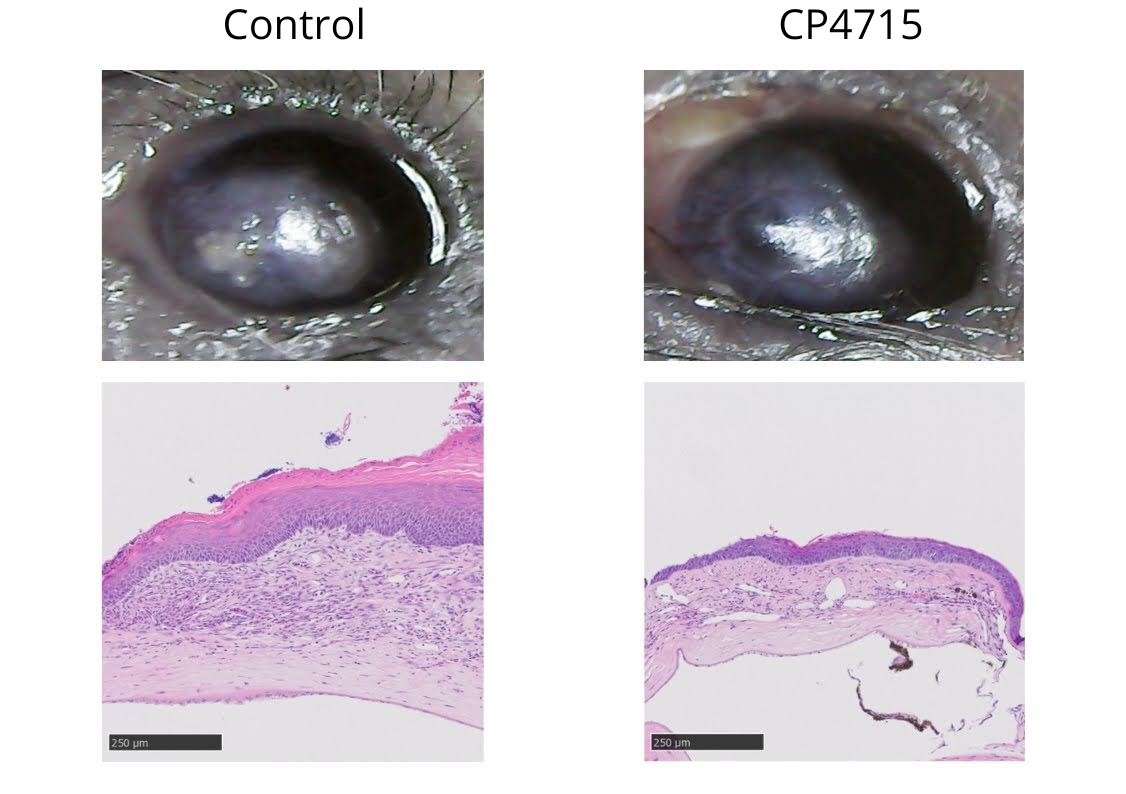
In parallel with the mouse studies, Akira Matsuda, an associate professor of ophthalmology at Nihon University's Itabashi Hospital, is conducting comparative analyses using excised specimens, such as palpebral conjunctival papillae, from patients with atopic keratoconjunctivitis.
Aiming to complete preclinical testing within two years
Izuhara and colleagues say they are currently at the preclinical stage, evaluating differences in efficacy compared with existing eye drops, selecting candidate solvents to dissolve the compound, and addressing other formulation issues. They are also holding discussions with an eye-drop manufacturer toward producing an actual drug. While noting challenges such as research funding, they say they aim to complete preclinical testing within about two years.
For the final product, the team is considering development either as eye drops or as an eyelid cream. They say they are moving toward obtaining approval as a drug for patients with severe atopic keratoconjunctivitis, while noting that in the future the therapy could also expand treatment options for people with mild symptoms, alongside existing drugs.
“Across medicine, treatment is moving toward molecular targeting – pinpoint suppression of disease causes to avoid side effects. In conjunctivitis, however, there have been no molecular targeted drugs until now," Izuhara concludes. "If research and development of this atopic keratoconjunctivitis therapy advances further in parallel with drug discovery for atopic dermatitis, it will have major scientific and medical significance."
Translated by Mizuki Nagakawa | JStories
Edited by Mark Goldsmith
Top photo: Envato
For inquiries regarding this article, please contact jstories@pacificbridge.jp
***
Click here for the Japanese version of the article
_smallthumbnail.jpg)











![[Interview] When digital and physical worlds meet](https://storage.googleapis.com/jstories-cms.appspot.com/images/1747974430456unnamed-2_smallthumbnail.png)

![[Interview] How Japanese musician Grover turned his passion of ‘sound’ into a health-tech startup](https://storage.googleapis.com/jstories-cms.appspot.com/images/1746181078493R7__1407_smallthumbnail.jpg)